A vegan face serum for men skips every animal-derived input — no lanolin, no collagen, no carmine — and OLIRS ships that as a default across the catalog, not a special edition.
- A true vegan face serum for men has zero animal-derived inputs and a third-party cert to prove it — self-declared 'vegan' on a label means nothing.
- All-In-One Facial Oil traces its jojoba, rosehip and sea-buckthorn to named regions and is cold-pressed — Buy for anyone who wants FROM FARM TO FACE proof.
- Peptide Firm-Look Serum uses Hexapeptide-11 from European bio-fermentation, not an animal-sourced peptide — Consider it for a firmer-looking daily layer.
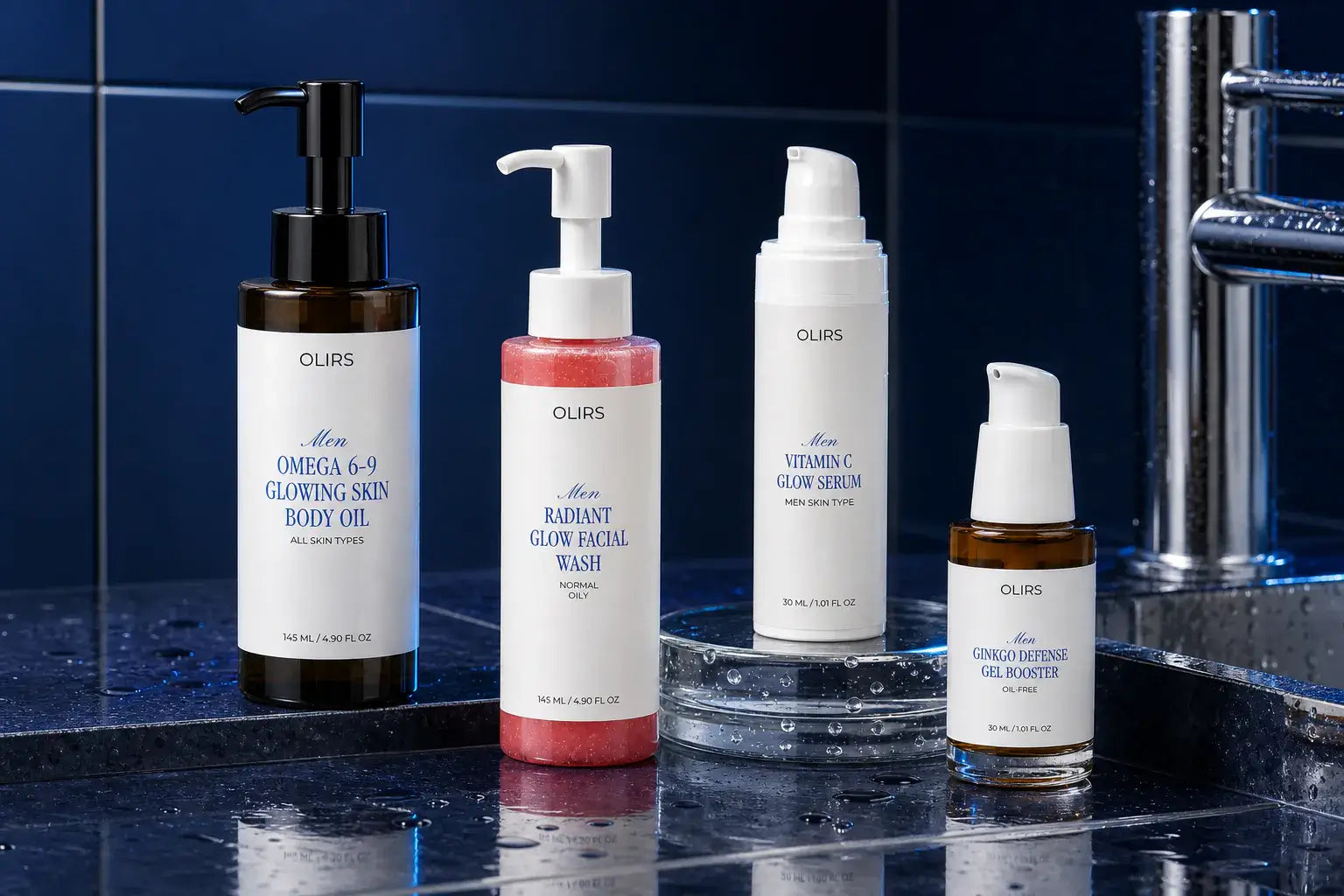
- Vitamin C Glow Serum pairs stabilised vitamin C with ferulic acid for a brighter-looking complexion — Buy for daytime use.
- Check the INCI for glycerin, squalane and stearic acid sourcing before you trust any 'natural' claim in 2026 — those three can come from either plant or animal fat.
Why this matters
"Vegan" on a skincare label is unregulated in the US in 2026 — a brand can print it without a certifying body ever checking a single ingredient. That's a problem if you're avoiding animal-derived inputs on principle, not just avoiding the word "animal" on a box.
The fix is boring and it works: check for a third-party vegan certification, then read the INCI yourself. OLIRS certifies its full lineup — Vegan, Cruelty-Free, and COSMOS NATURAL through Ecocert — rather than relying on the word alone. That's the difference between a claim and an audit.
Who this is for
This guide is for the man who won't buy a serum without checking what's actually in it — whether that's an ethical line he's drawn or just a habit of reading labels before he buys anything. He's not looking for a miracle claim. He wants to know if the hyaluronic acid is fermented or animal-sourced, whether the glycerin came from a plant, and whether "vegan" on the front of the bottle actually means something on the back.
What to look for in a vegan face serum for men
A certification, not a claim
A vegan logo on a bottle is meaningless without a body behind it. Look for a named certifier — the audit is the point, not the word. A serum that skips this step is asking you to take its word for it, which is exactly the thing a label-reader doesn't do.
Ingredients that can go either way
Glycerin, squalane, and stearic acid are the three to watch in 2026 — all three exist in both plant and animal-derived versions, and the INCI name looks identical either way. A genuinely vegan formula sources these from plant fats (usually coconut, palm, or olive) and should say so if asked. If a brand can't answer that question directly, that's your answer.
COSMOS NATURAL as a mechanism, not a badge
COSMOS NATURAL means a third party — Ecocert, in OLIRS's case — audited every ingredient and how it was extracted. It's not the same as "organic," and it's not the same as "clean." It tells you the extraction method was checked, which matters more than most marketing copy admits.
Cruelty-free is a separate claim from vegan
A formula can be cruelty-free and still contain animal-derived ingredients like beeswax or lanolin, sourced without testing on animals. Vegan and cruelty-free solve different problems. If avoiding animal inputs is the actual goal, check both boxes separately — don't assume one implies the other.
Traceable sourcing, where it exists
Most face serums list an ingredient by INCI name and stop there. A smaller number can tell you which region an oil came from and how it was pressed. That level of detail is rare in 2026 skincare marketing precisely because most brands can't back it up — when a brand can, it's worth noting.
Actives that don't need an animal source
Retinol alternatives like bakuchiol, peptides from bio-fermentation, and stabilised vitamin C all do their job without touching an animal-derived input. None of them fix scarring or reverse aging — they support the appearance of firmer, smoother-looking, more even-toned skin, and that's a meaningfully smaller promise than most category copy makes.
Top picks
All-In-One Facial Oil — the farm-to-face pick
This is one of only two products in the OLIRS catalog that can back the FROM FARM TO FACE slogan with real sourcing: jojoba from the Mediterranean basin, rosehip from Carpathian Eastern Europe, sea-buckthorn from the Himalayan and Central Asian region, all cold-pressed. Cold-pressing keeps more of the oil's natural compounds intact than heat extraction does, which is the actual reason the method gets named on the label instead of left off it.
It's a single-oil formula, so it layers under a moisturizer rather than replacing one. Verdict: Buy — for anyone who wants a serum where the origin story is checkable, not implied. All-In-One Facial Oil is the one product here that earns the slogan outright.
Peptide Firm-Look Serum — the actives pick
Hexapeptide-11 sourced from European bio-fermentation, paired with two molecular weights of hyaluronic acid and a Mediterranean aloe base. This is partial farm-to-face — the aloe and peptide origin are documented, the rest of the formula isn't region-specific.
Peptides support the appearance of firmness and fine lines over daily use; they don't restructure skin. Verdict: Consider — for the man past 30 who wants a daily layer with a documented, non-animal peptide source and isn't expecting an overnight change. Peptide Firm-Look Serum is the pick if the mechanism matters more to you than the marketing.
Vitamin C Glow Serum — the brightening pick
Stabilised vitamin C plus ferulic acid, aimed at a brighter-looking, more even complexion. Vitamin C oxidizes fast once opened — a properly stabilised formula and dark packaging both matter more than the concentration number printed on the front.
This is a daytime layer, not a night serum, and it does one job: it supports the appearance of evenness, nothing more. Verdict: Buy — for a morning routine that needs one active step, not five. Vitamin C Glow Serum fits that slot without adding complexity.


Hydrating Serum and Overnight AHA Exfoliating Serum round out a full week without repeating an active: Hydrating Serum for a plain moisture layer, the AHA serum for one or two nights a week when texture is the issue, not dryness.
What to avoid
- A vegan claim with no certifier named. If the bottle says "vegan" and nothing else, nobody outside the company checked that. Ask for the certification body or move on.
- "Natural" used as a stand-in for vegan. They're not the same claim. A natural-origin formula can still contain beeswax or honey extract. Read the INCI, don't infer from the word "natural" on the front.
- Retinol marketed as an active with no source disclosed. Some anti-aging serums pair retinol with capsule delivery systems that use gelatin — an animal-derived binder. Bakuchiol and peptide-based alternatives sidestep that question entirely.
Verdict comparison
| Product | Best for | Key active | Origin detail | Verdict |
|---|---|---|---|---|
| All-In-One Facial Oil | Full FROM FARM TO FACE proof | Cold-pressed jojoba, rosehip, sea-buckthorn | Region-named, cold-pressed | Buy |
| Peptide Firm-Look Serum | Daily firmness layer | Hexapeptide-11, dual-weight HA | Partial — peptide and aloe sourced | Consider |
| Vitamin C Glow Serum | Morning brightening step | Stabilised vitamin C, ferulic acid | Not region-specific | Buy |
| Hydrating Serum | Plain daily moisture | Bisabolol | Not region-specific | Consider |
| Overnight AHA Exfoliating Serum | Weekly texture step | Lactic acid | Not region-specific | Consider |
FAQ
What makes a face serum vegan?
A vegan face serum contains zero animal-derived ingredients — no lanolin, collagen, beeswax, carmine, or animal-sourced glycerin. The strongest proof is a named third-party certification, not just the word 'vegan' printed on the bottle.
Is vegan skincare better for men's skin?
Vegan skincare isn't inherently better for skin — it's a sourcing standard, not a performance claim. A vegan serum works as well as its actives and formulation allow, the same as any other serum.
What's the difference between vegan and cruelty-free skincare?
Vegan means no animal-derived ingredients; cruelty-free means no animal testing during development. A product can be one without the other — check both labels separately if avoiding both matters to you.
What does COSMOS NATURAL certification actually mean?
COSMOS NATURAL means a third-party body, in OLIRS's case Ecocert, audited every ingredient and how it was extracted. It's a natural-origin standard, and it's a different certification from COSMOS ORGANIC.
Is bakuchiol vegan?
Bakuchiol is a plant-derived compound extracted from Psoralea corylifolia seeds, so it's vegan by default. Check the full serum formula around it, since a supporting ingredient could still be animal-sourced.
How much does a vegan face serum for men cost in 2026?
Vegan-certified face serums for men typically run $25 to $45 depending on the active ingredient and packaging. Vitamin C and hyaluronic acid formulas sit at the lower end; peptide and multi-active serums sit higher.
Can a vegan serum still contain synthetic ingredients?
Yes — vegan only rules out animal-derived inputs, not synthetic ones. Many stabilised actives, like the vitamin C form used in most modern serums, are synthesized rather than plant-extracted, and that doesn't conflict with a vegan claim.
Do vegan serums work as well as retinol?
Plant-derived retinol alternatives like bakuchiol work more slowly than retinol and cause less peeling for most users. Retinol itself isn't automatically non-vegan, but some delivery capsules use animal-derived gelatin, so the full formula needs checking either way.
One last thing
Most of the catalog can't back the FROM FARM TO FACE slogan with a named region and extraction method — only All-In-One Facial Oil and a cleansing milk currently can, and that's stated plainly rather than stretched across every product page. That gap is worth knowing before you buy on the slogan alone in 2026: the two products that earn it are worth the extra look, and the rest earn it as their sourcing data gets filled in.